Your Cart is Empty
Menu


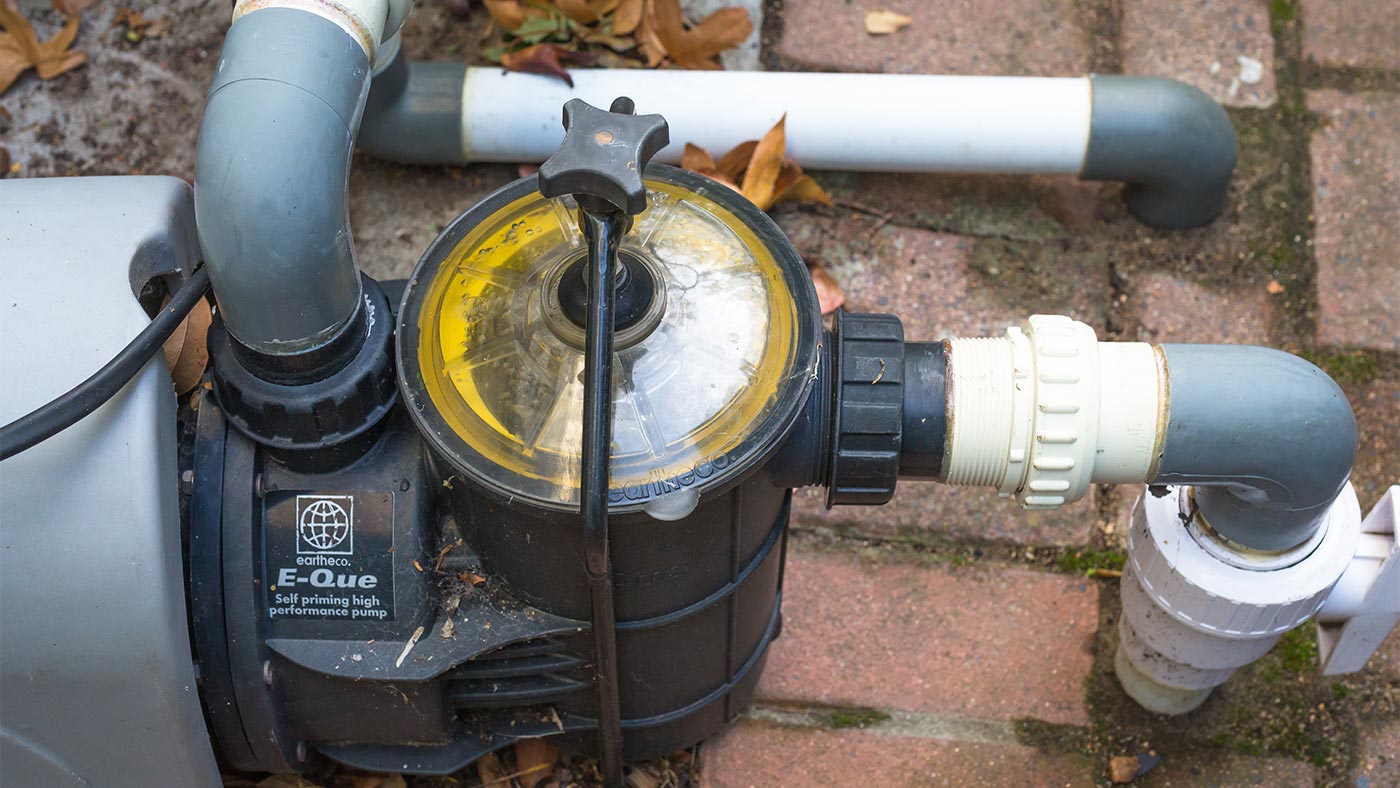

How to replace a pool pump
September 17, 2026 7 min read
A pump that's screaming, leaking, or tripping the breaker doesn't have to mean a service call. If the new pump lines up with your existing plumbing, most replacements take a few hours. This guide walks through measuring for a drop-in fit, plumbing with unions, wiring and bonding, priming without damaging the seal, and setting up a variable-speed schedule that lowers your power bill.
The short version
- Match the port size, suction height, voltage and horsepower of your old pump.
- Kill power at the breaker and confirm it's dead.
- Cut out the old pump and plumb the new one with unions on both sides.
- Reconnect power, ground and the bonding wire.
- Prime: fill the strainer pot, open the filter air relief and start the pump.
- Program a low-speed schedule that still skims, filters and satisfies your heater and salt cell.
Before you buy: why most replacements are now variable-speed
Since July 19, 2021, federal efficiency standards for pool pumps have set a minimum efficiency that, in practice, only variable-speed motors can meet for most inground filter pumps (roughly 1 HP and up). New pumps also have to ship with a timer. If your old pump is a 1 HP or larger single-speed, your replacement will almost certainly be variable-speed.
That works in your favor. Pump power drops with the cube of speed, so a pump running at half speed uses roughly one-eighth of the energy in theory. Long, slow run times filter just as well as short, fast ones and cost far less. How much you save depends on your schedule and your electric rate.
Measure your existing setup
Take these measurements before you order. They decide whether the swap is a drop-in or a re-plumb.
| What to check | How | Why it matters |
|---|---|---|
| Pipe size | 1-1/2" PVC measures about 1.9" across the outside. 2" PVC measures about 2-3/8". | Most new pumps have 2" ports and ship with adapters or unions for 1-1/2" pipe. |
| Suction port height | Measure from the pad to the center of the inlet port. | If the new pump sits lower, a riser base keeps you from forcing the pipe. |
| Port-to-port distance | Measure from the inlet to the center of the discharge port. | Tells you how much pipe to cut or add. |
| Voltage | Check the motor label and the breaker. A single-pole breaker is usually 115V; a double-pole breaker is 230V. | Many variable-speed pumps are dual-voltage, but some run on 230V only. |
| Horsepower | Read the total HP (THP) on the motor label. | Match it or go smaller. A variable-speed pump is tuned by speed, so bigger isn't better. |
| What depends on the pump | List your heater, salt cell, pressure cleaner, spa jets and water features. | Each one needs a minimum flow, which sets your lowest usable speed. |
Tools and parts
- New pump (plus a riser base if needed)
- Two unions, if the pump doesn't include them
- Schedule 40 PVC pipe and couplings to match your plumbing
- PVC primer and pressure-rated PVC cement
- PTFE (Teflon) tape for threaded adapters
- Silicone-based O-ring lubricant (not petroleum jelly)
- PVC saw or ratchet cutter, tape measure, marker
- Non-contact voltage tester, screwdrivers, nut drivers
- #8 solid copper wire and a lug, if the old bonding wire is damaged
Step 1: Shut down and isolate
- Turn the pump off at the timer or automation, then switch off the breaker. Confirm the power is off with a tester.
- Close the suction and return valves. If your pump sits below the water level, skipping this step will flood the pad when you open the pump.
- Remove the drain plugs and let the pump housing empty.
Step 2: Remove the old pump
- Photograph the wiring before you touch it. Note which wires land on which terminals and where the voltage selector is set.
- Disconnect the supply wires, the ground, the conduit fitting and the bonding wire.
- If the old pump has unions, unscrew them. If it's glued in, cut the pipe as close to the pump as you can so you keep as much straight pipe as possible to glue onto.
Step 3: Plumb the new pump with unions
Unions turn your next pump swap into an unscrew-and-lift job. Put one on the suction side and one on the discharge side.
- Install the port fittings. Many variable-speed pumps ship with union adapters that seal with an O-ring and need no tape. For threaded male adapters, use 3–4 wraps of PTFE tape in the direction of the threads. Hand-tighten, then snug gently. Pump ports are plastic and crack when overtightened. Avoid pipe dope unless the pump manufacturer approves it.
- Set the pump. Place it on a level pad. If the suction port is lower than the pipe, use a riser base rather than bending the pipe to meet it.
- Dry-fit everything. The pipe should meet each port without pushing or pulling. A pump held in place by stressed pipe will leak or crack.
- Prime and glue. Apply primer, then cement, to both the pipe and the fitting. Push the joint together with a quarter turn and hold it for 30 seconds. Keep cement away from union threads and O-ring faces.
- Keep the suction side straight. Avoid putting a 90° elbow right at the pump inlet. A short straight run into the pump cuts turbulence and noise.
- Let it cure. Follow the cure time on the cement can before you pressurize the system. It gets longer in cool or humid weather.
Step 4: Wiring and bonding
- If the pump is dual-voltage, set the selector to match your circuit before connecting power.
- Connect the line conductors and the equipment ground exactly as the pump's wiring diagram shows.
- Reattach the #8 solid copper bonding wire to the bonding lug on the motor. Bonding ties the pump into your pool's equipotential grid. It isn't the same as the ground wire, and code requires both.
- If the pump connects to automation, run the communication cable and set the pump address as the manual describes.
Know when to hand this off. Current electrical codes require GFCI protection on pool pump motors, including 230V circuits (the exact rule depends on which code edition your city uses). Some older GFCI breakers nuisance-trip with variable-speed drives, so use the breaker type your pump manufacturer recommends. If you need a new circuit, a voltage change or a panel upgrade, call a licensed electrician.
Step 5: Prime the pump without running it dry
A pump running without water can wreck its shaft seal within minutes. Take a moment to prime it properly.
- Open the suction and return valves.
- Remove the strainer lid and fill the pot with water up to the inlet.
- Clean the lid O-ring and coat it lightly with silicone-based lubricant. Petroleum products make O-rings swell. Hand-tighten the lid.
- Open the air relief valve on top of your filter.
- Turn the breaker back on and start the pump. Most variable-speed pumps run a priming cycle at high speed automatically. If yours doesn't, set a high speed for the first few minutes.
- Watch the lid. The pot should fill and stay full within a few minutes. When a steady stream of water comes out of the air relief valve, close it.
- If the pump hasn't primed after about 5 minutes, shut it off, refill the pot and look for an air leak before trying again.
Priming and start-up troubleshooting
| Symptom | Likely cause |
|---|---|
| Steady bubbles in the pump basket | Air leak on the suction side: lid O-ring, drain plug O-rings, suction union, valve stem or a cracked fitting. |
| Won't prime at all | Low water in the skimmer, a closed valve, a clogged skimmer basket or impeller, or the pump sits too far above the water. |
| Water dripping under the motor | Shaft seal. Replace it promptly before water reaches the motor bearings. |
| Grinding or rattling | Cavitation from a suction restriction, or worn bearings. |
| Display error code | Look it up in the manual. Many codes point to voltage, overheating or communication issues. |
Step 6: Program a variable-speed schedule
A variable-speed pump only saves money if you schedule it well. Start with turnover, the time it takes to move your pool's full volume through the filter:
Hours per turnover = pool gallons ÷ flow (GPM) ÷ 60
A 20,000-gallon pool at 30 GPM turns over in about 11 hours. Not sure of your volume? Use our pool volume calculator.
Sample schedule (about 20,000 gallons, Texas summer)
| Time | Speed | Purpose |
|---|---|---|
| 8:00–10:00 AM | High (about 2,600–3,000 RPM) | Skimming, cleaner run, mixing chemicals |
| 10:00 AM–6:00 PM | Low (about 1,300–1,800 RPM) | Filtration and salt cell operation |
| 6:00–8:00 PM | Medium (about 2,000–2,400 RPM) | Evening skim or water feature (optional) |
| Overnight | Off (freeze protection on) | — |
Treat those RPMs as starting points. Your plumbing sets the real numbers. Then fine-tune:
- Find your lowest useful speed. It has to move debris across the skimmer, keep the salt cell's flow switch closed, and satisfy the heater's pressure switch whenever you're heating.
- Account for cleaners. Pressure-side cleaners with booster pumps and suction-side cleaners both need a higher speed while they run.
- Adjust for Texas heat. Add run time during heat waves, after storms and after heavy swim days.
- Use off-peak hours. If you're on a time-of-use electric plan, move the long low-speed block to cheaper hours.
- Turn on freeze protection. A pump that runs when temperatures drop near freezing protects your plumbing and equipment during a hard freeze.
- Avoid schedule conflicts. If automation controls the pump, clear the pump's built-in schedules so the two don't fight.
Watch filter pressure and water clarity for a week, then adjust.
Not sure which pump fits your pad?
Send us a photo of your equipment and the label on your old motor. We'll match a drop-in replacement and tell you exactly which fittings you need. Call (817) 587-4397 or shop pumps.
When to call a pro
- The new pump needs a different location or a re-plumbed pad.
- You need a new circuit, a voltage change or GFCI work.
- The pump still won't prime after you've checked every suction-side leak point.
- Your warranty requires professional installation. Check before you start.
Pool pump replacement FAQs
Can I replace a single-speed pump with a variable-speed pump?
Yes. It's the most common swap we see. Most variable-speed pumps come with union adapters for 1-1/2" and 2" pipe. Check your voltage first, because some models run on 230V only.
What size pump do I need?
Match your old pump's horsepower or go smaller. Also make sure its top flow doesn't exceed what your filter and heater are rated for. With variable-speed pumps you set the flow with speed, not motor size.
How long should I run my pool pump?
Aim for about one full turnover a day, mostly at low speed. In peak Texas summer, many pools need more.
Do I need to re-prime every time the pump turns on?
No. Self-priming pumps keep water in the strainer pot. You only re-prime after draining the pump, opening the lid, or letting the water level drop below the skimmer.
Talk to a pool equipment specialist
Free shipping, $0 sales tax and a price match guarantee on pumps from Pentair, Hayward and more. Call (817) 587-4397. Installers and service companies can get trade pricing through our Commercial program. More how-tos are in our Installation Center.
PayPal Pay Later Messaging
Step 1: Choose message placement
Click the button below and then hover over your page to select a placement.
Step 2: Paste and save
You have copied the placement for the Product Page.
Go back to the App Embeds section, and in the Paypal Advanced Settings, paste the copied value into the Product Page field and click the 'Save' button in the top right corner.